Guide
5 Early Warning Signs an Account Is About to Go Delinquent
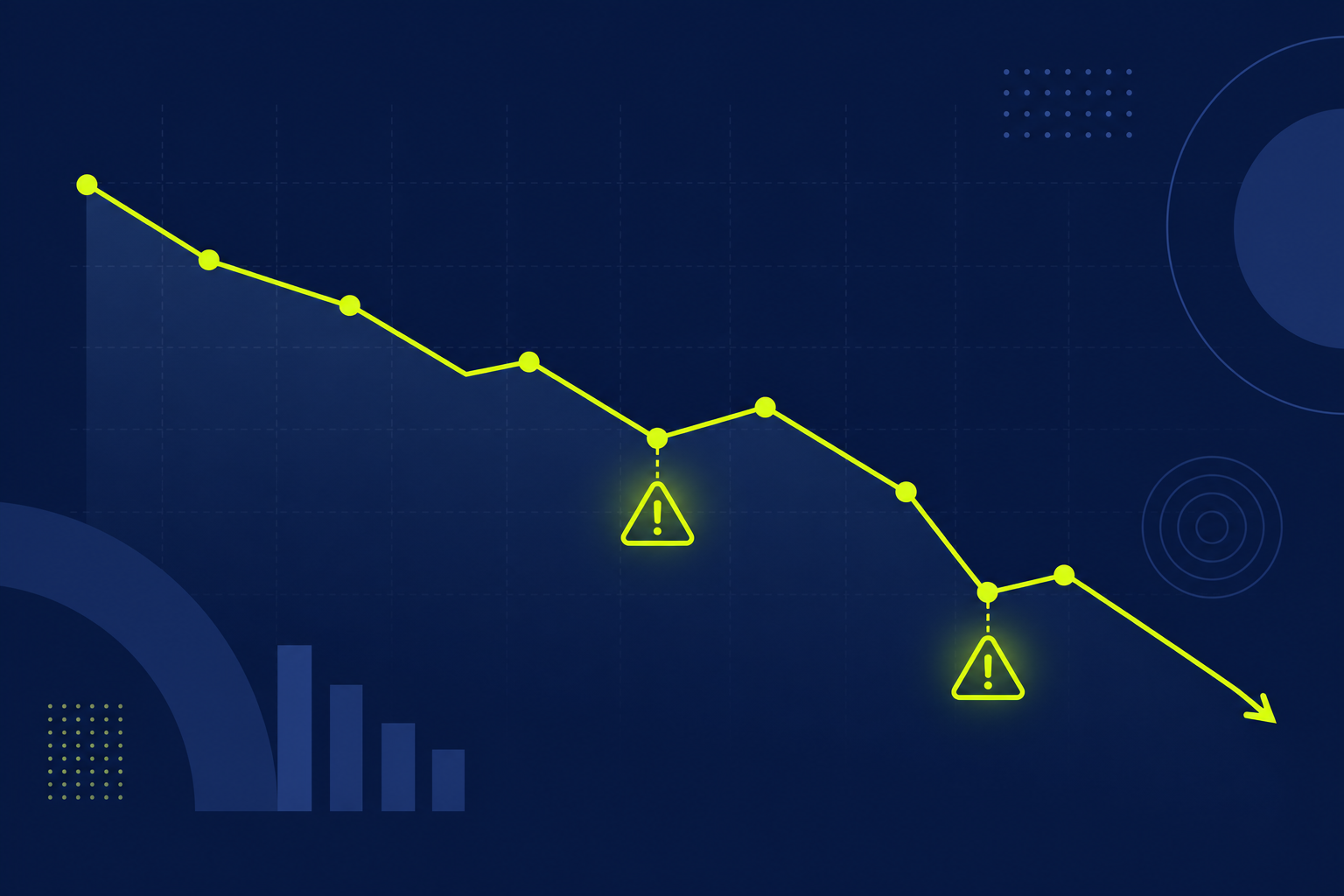
Most credit teams find out an account is in trouble the same way: it shows up 30, 60, then 90 days past due on the aging report. By then, you're not managing risk anymore, you're doing collections.
The accounts that eventually go delinquent almost always send signals first. The problem is that those signals are scattered across a bureau pull nobody re-ran, an AR report nobody re-read, and a gut feeling nobody wrote down. Here are the five that matter most, and how to actually catch them in time.
1. Payment timing quietly drifts later
An account that has paid net-30 like clockwork for two years suddenly starts paying on day 34. Then day 38. Each individual invoice still gets paid (nothing trips your standard "past due" alert), but the trend line is the alert. A single late payment is noise. Three invoices in a row trending later is a pattern, and patterns predict the next 90 days better than any single data point.
2. Order size or frequency changes sharply
A sudden jump in order volume from a customer who's stretched thin isn't always good news, sometimes it's a sign they're trying to draw down every dollar of available credit before something breaks. Conversely, a longtime customer who quietly stops ordering as often may be diverting purchases to a competitor who's willing to extend easier terms, which is its own kind of risk signal for the receivable you're still holding.
3. Promises to pay start replacing payments
Once a customer starts proactively calling to explain why a payment will be late, or asking for a partial payment plan, the relationship has shifted. This is usually well-intentioned (most customers genuinely plan to make good), but it's also one of the most reliable leading indicators of an account that will need active management, not passive net-30 terms, for the foreseeable future.
4. Their own customers or industry are under pressure
Credit risk is rarely isolated. If an account's core end market is contracting, or if the business itself operates in a sector seeing a wave of bankruptcies or slowdowns, that pressure eventually shows up in how they pay you, even before it shows up in their own financials. Monitoring at the account level only, with no visibility into the book-wide trend, means you catch this last instead of first.
5. Bureau or trade data goes stale, and nobody notices
The most common failure mode isn't a missed signal. It's that nobody was watching. Most credit limits are set once at onboarding and never revisited unless someone happens to remember. A limit that was appropriate 18 months ago, based on data that's 18 months old, isn't a credit decision anymore, it's a guess wearing a number.
The fix isn't more manual reviews, it's continuous monitoring
Every one of these signals is detectable from data you likely already have: payment history, order patterns, and refreshed bureau or trade data. The reason most teams miss them isn't lack of access, it's that reviewing every account by hand, every week, doesn't scale past a few dozen customers.
That's exactly the gap Thor's risk monitoring is built to close: every account on your book gets re-scored automatically, on a rolling basis, and you get flagged the moment one of these patterns emerges, not the moment it turns into a past-due invoice.
If you want to see what that looks like against your own accounts, book a free demo and we'll walk through it live.